The Problem with Perseus and Medusa Imagery.
• Roopesh Singh
Perseus and Medusa in the act. Inspired by Canova’s sculpture.
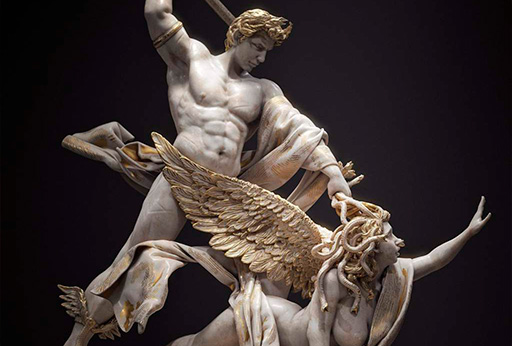
The Problem: Why the Perseus and Medusa Imagery/Sculpture Fails as poster for International Falsely Accused Day.
I was having a debate with someone about the imagery used for International Falsely Accused Day. The person on the other side was convinced the image, a sculpture of Perseus holding Medusa’s head, was perfect. I had a different point of view, and I couldn’t help but feel that using this imagery, without proper reflection, is profoundly problematic.
My critique is rooted in an abstract idea, it’s not about gender, but about the message carried by the essence of the myth. This imagery or depiction gives us a clear message - a beautiful essence, which can be interpreted as purity of abstract, is punished in this mortal world. Storytelling and artistic depictions have, whether intentionally or unintentionally, invariably carried this message over the centuries since its inception. This also asks us to reflect that the essence of true beauty, no matter how narratives are shaped in any era, cannot hide its purity.
Injustice in Three Eras
The essence of injustice is perpetual, and we can trace it in a three act journey from antiquity to the modern day.
Act I: The Ancient Injustice
In ancient times, in historical Greek mythology, Medusa is described as a beauty that allures everyone, not by intention, but because of her mere existence. This beauty gets “raped,” a term that must be used carefully in mythological stories, as it signifies some kind of injustice rather than necessarily its modern literal meaning. This injustice against Medusa happens in the temple of Athena, committed by Poseidon. The writer, in using the characters of Athena and Poseidon, and especially Athena’s temple, the goddess of wisdom, subtly introduces the idea of injustice Medusa endures in her own temple of justice and wisdom. This makes you question not only the injustice itself, but also the very agents who are supposed to deliver justice.
Act II: The Medieval Vilification
In the medieval era, the Roman writer Ovid goes further and reframes the story, inverting Medusa’s beauty into ugliness. A monster is created. At this point, two things happen, the original injustice remains, but a new layer of injustice is introduced, she is now a monster. Despite this devastating interpretation, the essence of her purity survives. This essence, which will be picked up again in the next era, is not passive; it is an active power of purity that cannot be contained.
Act III: The Modern Reinterpretation and the Meta-Level Critique
In the modern era, the image and the poster pick up that purity and carve out her beauty and depict her as innocent. She transforms again, from Roman ugliness back to a modern passive beauty, to her original ancient alluring beauty. This new work, inspired by Canova’s sculpture, demonstrates that the essence survives once more. The essence of her purity, despite the layers of Roman ugliness and ancient injustice in Athena’s temple, is unaffected and is picked up by artists in every era. By bringing her beauty back, the artist is removing the medieval injustice.
Again, this survival of purity is not a form of passivity but an active agent. The artist then goes back to the story of ancient times. In the image, the artist depicts Perseus about to behead Medusa but hasn’t fully done so; the moment is locked in a time capsule. The artist is now playing on the meta-level by freezing the era, the Greek myth, and the beauty of Medusa. On a meta-level analysis, this depiction, regardless of the artist’s true intent, is flipping the narrative on many levels. It addresses the historical reinterpretations of Medusa as an injustice by bringing back her beauty. This is the new reinterpretation, going from an alluring beauty to a demon-like figure is challenged as the artist brings her back, making her look innocent in the sculpture.
After doing this, he then depicts Perseus as a symbol of justice, but he does so without making Medusa look monstrous. He flips the narrative again, making you question the so-called justice delivered by Perseus. This act of “justice” is actually the problem; it’s the same kind of injustice as Athena’s in the story, but it is now frozen in the sculpture. By freezing the moment in the act, but not its completion, and by bringing Medusa’s beauty back, it asks you to question the delivery of justice itself. Possibly, Medusa is not only a victim of historical reinterpretations but also a victim in the sculpture, by being made to look beautiful while still passively incurring injustice. This continues to this day, as it perpetuates the injustice carried throughout history by being used as a poster for International Falsely Accused Day.
Conclusion: Final Thought
The key takeaway: We must free Medusa and her beauty. The beauty of pure essence of abstract representing innocence.
If this imagery is to be used as poster for the International Falsely Accused Day, it must be used as Medusa being falsely accused, not as Perseus delivering justice as a justice delivery agent. Even if we decide do that, it perpetuates injustice, like in every other era. The meta-level analysis and understanding imagery is problematic.